
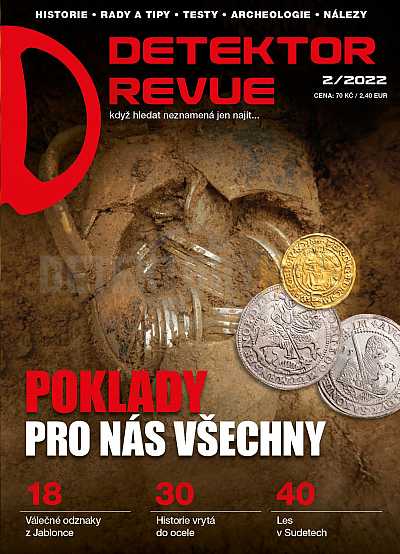
Detektor revue 2/2022
Treasures for us all
War badges from Jablonec · History etched in steel · The Forest in the Sudetenland
This is an introduction to a Czech-language printed issue, not a translated edition of the magazine.
Poklady pro nás všechny
Original Czech issue ↗Your discovery. A new audience.
Authors receive a copy of the issue in which their contribution is published. We can also discuss further collaboration.
Become a contributor →Machine translation of the original editorial information.
Availability and current price are confirmed by the shop.
Inside this issue
- 18 · War badges from Jablonec
- 30 · History etched in steel
- 40 · The Forest in the Sudetenland
Dear readers,
I’m sure you’ll agree that we’re not exactly going through the happiest of times; negative news is coming at us from all sides, and so – as they say – any good news is welcome. We hope that our own will join their ranks: the second issue of this year’s Detektor Revue has just rolled off the press, and we trust that the varied selection of articles we have prepared for you will allow you to forget your worries and problems for a while, and that everyone will find something of interest to read, which may serve as inspiration for your own searches, but also – as we never fail to emphasise – perhaps also a stimulus to write an interesting article of your own.
The editorial team wishes you good health, happiness and as many wonderful finds as possible!
So what can you look forward to in Detektor Revue No. 2?
In the opening section, ‘Artefact of the Month’, under the heading ‘Artillery Parade’, we present a unique, perfectly preserved artillery tunic for non-commissioned officers. ‘Treasures for Us All’ is the title of an interview conducted by Kasander with Filip Krásný, an archaeologist at the Mladá Boleslav Museum, about the recovery of a coin hoard from the Thirty Years’ War. What do you consider to be the biggest ‘nuisance’ when searching? This is a slightly provocative question that we put to treasure hunters in the next instalment of your favourite survey. ‘With a boar in the Rusolág’ – that is what Luděk called his account of an encounter with a boar whilst searching, and he took this event as an opportunity to introduce one particular location. In our regular column ‘Let’s Save History’, we use examples of artefacts that have been handed in to show how treasure hunters are helping to preserve our archaeological heritage. A remarkable publication on the history of badge production in Jablonec nad Nisou during the Second World War has appeared on the market – we present an interview with the author, Pavel Strejček, under the headline ‘Hitler despised the Jablonec manufacturers’. What follows is an investigative article by our long-standing contributor Manuel van Eyck, who has been investigating the tragic fate of Czechoslovak paratroopers who sacrificed their lives for their country, yet to this day have not been given a dignified burial. He provocatively titled the article ‘The Forgotten’. ‘History Engraved in Steel’ is the title of an article in which PetkoZberatel, an enthusiastic collector of edged weapons, presents – this time – a relatively common, yet – as the article aptly demonstrates – exceptionally interesting Austro-Hungarian trench knife, model 1917. The Institute of Archaeology of the Czech Academy of Sciences in Brno has produced a clear and inspiring guide on how to become involved in citizen science in archaeology and contribute to the preservation of our country’s shared archaeological heritage. Every responsible treasure hunter should familiarise themselves with this – you’ll find it under the heading ‘Ten Principles for Responsible Metal Detectorists’. In this issue, too, you’ll find answers to your questions about button finds in the regular column ‘The Button Collector’s Advice’, prepared for you by button expert and collector Ivo Tomáš. Tomáš and his dad – a pair of treasure hunters already familiar to readers of Detektor Revue – set off for as yet unexplored parts of their region – and it paid off. Their report, full of interesting finds, is promisingly titled ‘The Forest in the Sudetenland’. Here is another chapter in the history of weapons, compiled for you by military historian Jan Škarka; in this instalment, he focuses on the heaviest weapon in the Austro-Hungarian artillery, used to provide direct fire support to combat troops:the 15 cm M.1894 and M.1899 battery howitzers. And, of course, we cannot conclude without a short story, this time penned by Rovin, which the author has simply titled ‘Radotín’.
Preview photographs


