
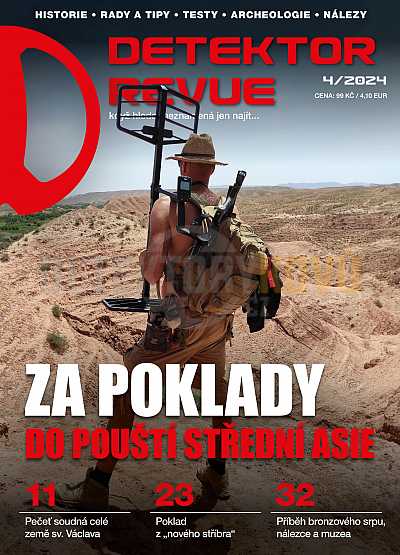
Detektor revue 4/2024
In search of treasures in the deserts of Central Asia
The judicial seal of the whole land of St. Václava · A ‘new silver’ hoard · The story of the bronze sickle, the finder and the museum
This is an introduction to a Czech-language printed issue, not a translated edition of the magazine.
Za poklady do pouští Střední Asie
Original Czech issue ↗Your discovery. A new audience.
Authors receive a copy of the issue in which their contribution is published. We can also discuss further collaboration.
Become a contributor →Machine translation of the original editorial information.
Availability and current price are confirmed by the shop.
Inside this issue
- 11 · The judicial seal of the whole land of St. Václava
- 23 · A ‘new silver’ hoard
- 32 · The story of the bronze sickle, the finder and the museum
Dear readers, the third issue of Detektor Revue this year has just rolled off the press, and we trust that you will all find something of interest to read, which may serve as inspiration for your own searches, or perhaps even prompt you to write an interesting article.
The editorial team wishes you good health, well-being and as many wonderful finds as possible in the coming autumn season!
To discover a well-preserved glass artefact that has survived intact in the ground for sixteen centuries is truly exceptional. It is precisely such an item that our introductory feature, ‘Artefact of the Month’, will introduce you to under the heading ‘Ancestors’ by Jakub Sklář.
Who wouldn’t be tempted to explore distant, exotic Asia? Miroslav UC Kratochvíl has done it – for the fourth time, he has set off with his metal detector on an international archaeological expedition to remote deserts and has shared his experiences with you in a report entitled ‘In Search of Treasures in the Deserts of Central Asia’.
You can read about the outcome of the almost detective-like investigation into the origins of an unusual artefact found whilst repairing the roof of an old cottage in northern Bohemia in the article ‘The Seal of the Realm of Saint Wenceslas’.
Are there still any ‘highly sought-after’ locations? That is the question we put to treasure hunters in the next instalment of your favourite Survey.
When did the first forgeries of medals and orders first appear historically? What should novice collectors who wish to collect orders or decorations of the Habsburg Monarchy know, and what should they avoid? You will learn this and many other interesting facts in the final instalment of an extensive interview with our leading expert on the phaleristics of the Habsburg Monarchy, Ivo Koláčný, entitled ‘For the Emperor and the Fatherland – The Phaleristic Legacy of Our Ancestors (III)’.
Below is an article about a thrilling find by treasure hunter Michal, entitled ‘The “New Silver” Treasure’.
The exhibition ‘Metal Detectors in Archaeology’ at the Comenius Museum in Přerov showcases finds recovered by metal detectorists in collaboration with archaeologists, including a unique ceramic vessel containing a collection of as-yet-unprepared Bronze Age bronze objects. You can see for yourself what the archaeologists spotted on the CT scan of the vessel in the article ‘A Glimpse into the Bronze Age’.
Josef Blaho, a collector and outstanding expert on WW2 decorations, presents the most interesting pieces from his collection in our magazine’s series ‘Medals Under the Magnifying Glass’. This time, it reveals the story hidden behind ‘The Order Born of the Sun’s Rays’.
‘The Story of the Bronze Sickle, the Finder and the Museum’ – this was the unusual title given to his article by the finder of the bronze sickle, in order to describe as vividly as possible the story of exemplary cooperation between the treasure hunter and the archaeologists.
In this issue, too, you’ll find answers to your questions about button finds in the regular column ‘The Button Collector’s Advice’, prepared for you by button expert and collector Ivo Tomáš.
Under the heading ‘Archaeology of Destruction (II)’, we present the continuation of an interview with archaeologist Tomáš Pancíř, who specialises in war archaeology. We discussed, amongst other things, the search for former Luftwaffe airfields in Finland, the ‘Golden Mammoth’, and what is being done to ensure that the victims of the horrors of war do not remain buried forever, simply left in a field or a ditch.
In our regular column ‘Let’s Save History’, we use examples of artefacts that have been handed in to show how treasure hunters are helping to preserve our archaeological heritage. This time, for example, we might look at a unique buckle from the early Migration Period or a Roman fibula.
Here is another chapter from the history of weapons, compiled for you by the renowned military historian Jan Škarka; in this instalment, he presents the 15 cm heavy howitzer model 18 and the 15 cm sFH 18.
And, of course, we cannot conclude without a short story, this time penned by Mirek Čáryfuk Hokeš, which the author has titled ‘Do Not Disturb Our Circles!’
We wish you pleasant summer reading
Editor-in-chief Zdeněk Kasander Procházka and publisher Miroslav UC Kratochvíl.
Preview photographs


