
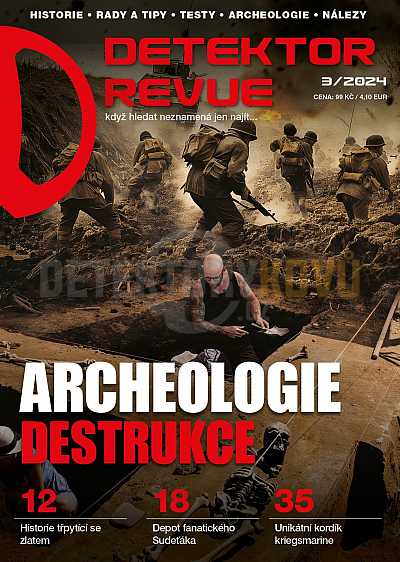
Detektor revue 3/2024
The archaeology of destruction
A history glistening with gold · A hoard belonging to a fanatical Sudeten German · A unique Kriegsmarine dagger
This is an introduction to a Czech-language printed issue, not a translated edition of the magazine.
Archeologie destrukce
Original Czech issue ↗Your discovery. A new audience.
Authors receive a copy of the issue in which their contribution is published. We can also discuss further collaboration.
Become a contributor →Machine translation of the original editorial information.
Availability and current price are confirmed by the shop.
Inside this issue
- 12 · A history glistening with gold
- 18 · A hoard belonging to a fanatical Sudeten German
- 35 · A unique Kriegsmarine dagger
Dear readers, the third issue of Detektor Revue this year has just rolled off the press, and we trust that you will all find something of interest to read, which may serve as inspiration for your own searches, or perhaps even prompt you to write an interesting article.
The editorial team wishes you good health, well-being and as many wonderful finds as possible this summer!
So what can you look forward to in Detektor Revue No. 3?
In the opening feature, ‘Artefact of the Month’, under the heading ‘A Message from the Bronze Age’, we will introduce you to an extraordinary metal-detector find: a three-thousand-year-old bronze hoard comprising eight axes, eight bracelets, two pins with spherical heads and one spearhead.
Archaeology of destruction – that is the title we gave to our interview with archaeologist Tomáš Pancíř, who specialises in war archaeology; amongst other things, we discussed the unusual discipline of ‘bombed archaeology’, the search for traces of the Second World War in Finland, the ‘Golden Mammoth’ and the wealth of finds hidden at our airports.
This was the thirteenth time we’d gathered for a friendly meet-up of treasure hunters with Detektorweb in Sloup v Čechách, though this brings the total number of such gatherings to 26. A photo report by Tomáš and Kasandra, ‘Sloup 2024’, gives an insight into how the meet went and how we enjoyed three wonderful days beneath the rock castle in Sloup.
Thanks to a conscientious and cooperative treasure hunter, the T. Museum has acquired G. M. in Rakovník: a find of exceptional cultural and historical value: a hoard of Celtic gold staters from the late Middle La Tène period. The article is provisionally titled ‘A History Glittering with Gold’.
In your life as a treasure hunter, have you encountered more goodwill or envy? That is the question we put to treasure hunters in the next instalment of your favourite Survey. You can answer this question for yourself too.
A hoard belonging to a fanatical Sudeten German. You’ll find out what thrilling discovery lies behind this enticing headline in the report by treasure hunter Kosti.
Which decorations were generally considered the most prestigious among the people during the Austro-Hungarian Empire? Which was the first imperial decoration used for the mass decoration of soldiers in our country? You will find this and many other interesting facts in the continuation of our interview with Ivo Koláčný, our leading expert on the faleristics of the Habsburg Monarchy, entitled ‘For the Emperor and the Fatherland – The Faleristic Legacy of Our Ancestors’.
In our regular column ‘Let’s Save History’, we use examples of artefacts that have been handed in to show how treasure hunters are helping to preserve our archaeological heritage. This time, for example, we’ll look at the metalwork of an Avar warrior’s belt, a Celtic amulet or a Punic coin evoking the scent of distant Mediterranean lands.
Josef Blaho, a collector and outstanding expert on WW2 decorations, presents the most interesting pieces from his collection in our magazine’s series ‘Medals Under the Magnifying Glass’. This time, it reveals the story behind the ‘Medal Born in the African Desert’.
PetkoZberatel, an enthusiastic collector and great connoisseur of bladed weapons, and his collectables have become an integral part of our magazine. This time, in the article ‘Kriegsmarine dagger – an attractive naval sidearm’, he delved into the history of the German Navy.
Here is another chapter from the history of weapons, compiled for you by the renowned military historian Jan Škarka; in this instalment, he presents a true symbol of the German army during the Second World War – the Model 18 light field howitzer.
And, of course, we cannot leave out a short story, this time penned by Slartibartfast, which the author has mysteriously titled ‘The Future Is Not What It Used to Be’.
In this issue, too, you’ll find answers to your questions about button finds in the regular column ‘The Button Collector’s Advice’, prepared for you by button expert and collector Ivo Tomáš.
We wish you pleasant summer reading
Editor-in-chief Zdeněk Kasander Procházka and publisher Miroslav UC Kratochvíl.
Preview photographs


